
•Dalton Walsh
Walking dog in the winter dark? Stay safer with UK winter tips on LED collars, hi-vis kit, head torches, icy pavements and road-safe routes.
By Dalton Walsh
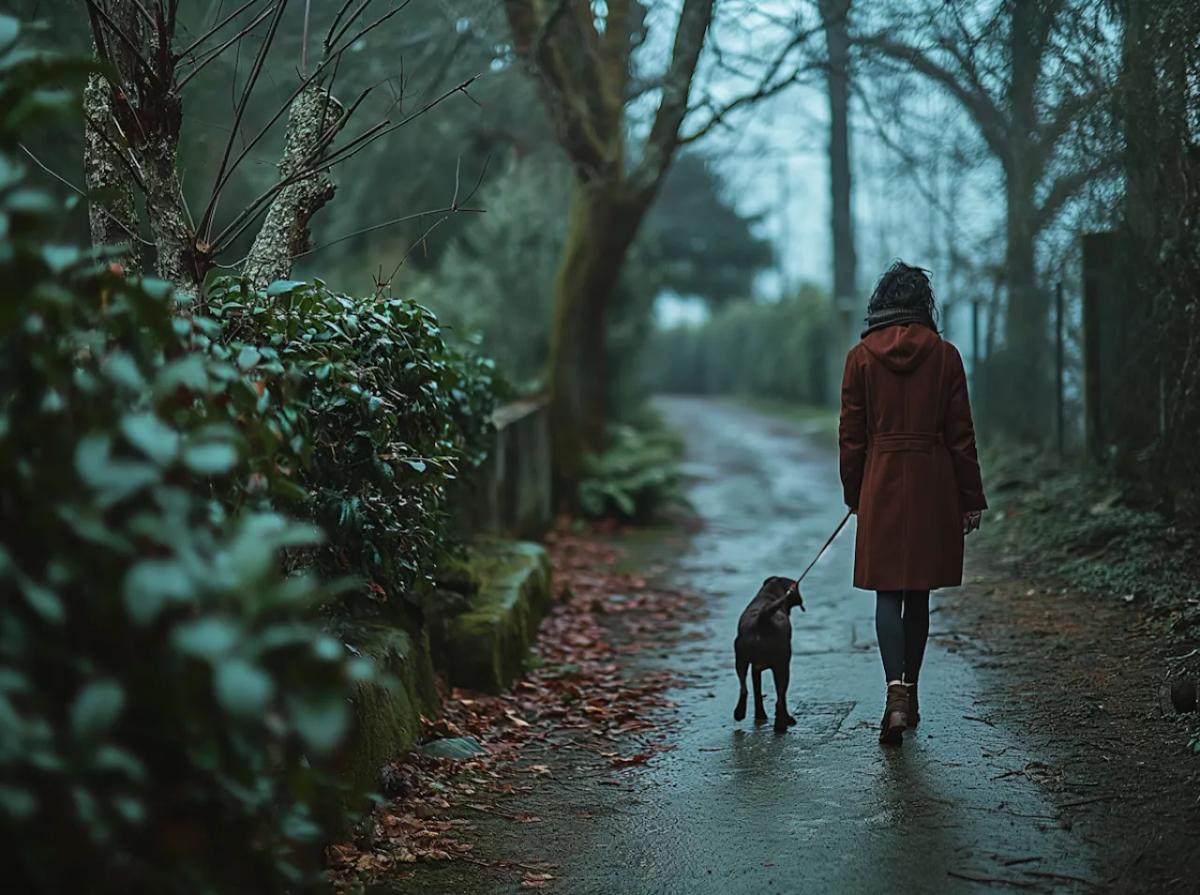
Dog walking in the dark is part of normal winter life in the UK. The clocks go back and suddenly your evening walk happens in pitch darkness. You can't see where your dog's gone, you can't see what they've found, and drivers definitely can't see either of you.
If you're walking dog in the winter dark because work, school runs or training nights eat the daylight, the safety basics matter more than usual: visibility, known routes, grip underfoot and keeping your dog close near roads.
Winter dog walking in the UK is a masterclass in stumbling around fields in the dark, stepping in things you'd rather not identify, and hoping that rustling sound is just your dog and not something else entirely.
But it doesn't have to be a hazard. With the right gear and a bit of planning, dark walks can actually be pretty peaceful. Quieter, fewer people, and your dog doesn't care what time it is.
Here's how to make walking your dog in the dark safer and slightly less chaotic.
Yes, dog walking in the dark can be safe if both you and your dog are visible, you stick to routes you know, and you keep your dog on lead anywhere near roads or poor visibility. Use an LED collar or collar light for your dog, wear hi-vis yourself, carry a head torch, and save new routes for daylight.
Winter dark walks need a bit more planning than summer evening walks. Check your route before you go, use active lights on your dog, wear hi-vis yourself, carry a proper torch and avoid new fields or unlit lanes when paths are icy, flooded or muddy.
The biggest winter change is footing. Icy pavements, frozen puddles, slippery wooden bridges and wet leaves can turn a normal route into a fall risk for both of you.
Drivers also have more to deal with in winter: glare, rain, fogged windscreens and poor visibility. A dark dog at kerb height is easy to miss, so use active lights rather than relying on reflective strips alone.
Dogs can disappear faster in fog, heavy rain or around hedges. More wildlife moves at dusk and after dark too, so keep excitable dogs closer if their recall drops when they spot movement.
Your awareness matters as much as your dog's kit. Hoods, hats and headphones can block traffic noise and make it harder to notice cyclists, runners or other dogs approaching from behind.
It's not just about seeing where you're going. When you walk in the dark, everything changes.
Visibility works both ways - you need to see your dog, but cars, cyclists, and other walkers need to see both of you. Wearing black and walking on unlit roads is asking for trouble.
Off-lead becomes riskier too. You can't see as far, your dog can disappear from sight in seconds, and recall gets harder when they can't easily see you either.
Then there's the hidden hazards. That pothole, that low branch, that suspicious pile of something - you won't spot them until it's too late. Dogs can also encounter things they shouldn't (dead animals, discarded food, wildlife).
And other people are unpredictable. Not everyone walking in the dark has good intentions. Even well-meaning people can startle your dog if they appear suddenly from nowhere.
None of this means you shouldn't walk in the dark. Your dog still needs exercise, and winter means limited daylight. But you do need to adapt.
The single most important thing you can do: make your dog visible. If you can only buy one piece of kit, this is it.
LED collars are brilliant. They're light-up collars that make your dog visible from hundreds of metres away. Most have multiple light modes - constant, slow flash, rapid flash.
Get a rechargeable one. Battery-powered collars are annoying (batteries always run out at the worst time). USB rechargeable collars hold charge for weeks of daily use and plug in like your phone.
Popular options include Illumiseen, BSeen, and Blazin. Sizing matters - measure your dog's neck and check the size chart. Too loose and it'll spin around or fall off.
Some dogs don't like the feel of a thicker collar. If yours is one of them, try a collar cover that slips over their existing collar instead.
If your dog walks on-lead in the dark, illuminated leads serve double duty - they light up your dog AND make you more visible.
Less essential than an LED collar, but useful if you're walking along roads. Drivers can see the whole outline of you and your dog, not just a floating lit-up collar.
Small clip-on lights that attach to your dog's existing collar. Cheaper than a full LED collar and easy to add and remove.
The downside is they can get knocked off if your dog barrels through undergrowth. They also only create a single point of light rather than a ring around the neck. Still, they're better than nothing and a good budget option.
Lights are active - they emit light. Reflective gear is passive - it bounces light back from car headlights and torches.
Reflective dog coats and reflective harnesses are useful backup, but they only work when light is shining on them. On a dark footpath with no cars around, reflective gear doesn't help much.
Best approach: combine lights (so you're always visible) with reflective gear (so you're extra visible to vehicles).
For most dark walks, an LED collar is the easiest way to spot your dog at distance. You can see the moving ring of light even when you cannot see the dog.
Clip-on collar lights are cheap and useful, but they can swing around or get knocked off if your dog crashes through cover.
Light-up leads help drivers see the space between you and your dog. Reflective coats and harnesses work best when you pair them with active lights, not instead of them.
If you walk every day through winter, choose rechargeable kit. It is less annoying than replacing batteries and easier to keep ready by the door.
Your dog isn't the only one who needs to be seen. You're out there too, probably wearing your usual dark dog-walking coat.
A simple hi-vis vest over your coat makes a massive difference. Looks ridiculous? Maybe. Gets you seen by cars? Definitely.
Alternatively, get a dog-walking coat that has built-in reflective strips. Many outdoor brands now include them as standard.
A good head torch makes a massive difference on dark walks. Hands-free light that points wherever you look. You can see the path, see your dog, see what they're eating, and find the poo bags in your pocket.
Get one with multiple brightness settings. You don't always need full beam - a lower setting saves battery and doesn't blind everyone you pass.
Red light mode is useful too. It preserves your night vision and doesn't startle wildlife as much. Some torches have both white and red LEDs.
Decent head torches: Petzl Actik, Ledlenser, Black Diamond. Don't cheap out on this - a dim head torch that dies mid-walk is worse than useless.
Your phone has a torch. It's fine in a pinch. But it's not ideal for regular use - it drains your battery, you have to hold it, and it doesn't stay pointed where you need it.
A proper torch (handheld or head-mounted) is worth having for regular dark walks.
When you let your dog off lead in the dark, keeping track of them becomes harder. Here's how to manage it.
If you're new to dark walks, start on-lead. Get used to the route, understand the hazards, see how your dog behaves. Then gradually allow more freedom as your confidence grows.
Some dogs should stay on-lead in the dark permanently. If your dog has dodgy recall in daylight, it won't improve when they can't see you properly.
This is where LED collars pay for themselves. A lit-up dog is visible from surprisingly far away. You might not be able to see them, but you can see that bobbing light across the field.
For dogs with poor recall, there's something to be said for training them to come TO the light. Torch on, call them, they see your light and come towards it. Works better than shouting into the darkness.
If you walk in areas where your dog could genuinely disappear, large woods, near roads or places with lots of wildlife, a GPS tracking device for dogs gives peace of mind.
They clip to the collar and let you track your dog's location on your phone. Some (like Tractive) need a subscription, others work via Bluetooth/Apple Find My network.
Not essential for most people, but valuable if you have an escape artist or walk in risky areas.
This might sound obvious, but recall needs to work in all conditions, including darkness.
Practice calling your dog when it's dark. Use your voice, use a whistle, use your torch. Make sure they can find their way back to you even when they can't see you clearly.
A lit-up collar helps them stand out, but they also need to be able to spot YOU. Your head torch beam, waving towards them, gives them something to aim for.
Where you walk in daylight might not be the best choice in the dark.
For weekday winter walks, choose lit loops and save field routes for daylight. Pavements, firm surfaces and easy exits are safer than new shortcuts through woods or across muddy fields.
Avoid narrow country lanes after school-run and commuter traffic if there is no pavement. If you train flyball in the evening, plan a short safe walk before or after training rather than trying a full dark field walk.
Now is not the time for exploring. Walk routes you know well, where you're familiar with the terrain, any hazards, and how to get back if something goes wrong.
That exciting new footpath through the woods? Save it for daylight. That reliable route around the playing fields? Perfect for dark walks.
Uneven ground is harder to navigate in the dark. Muddy fields with hidden holes become genuinely dangerous. Paved paths, well-maintained trails, and mown grass are safer bets.
If you do walk on rough terrain, go slower. Your head torch will show you what's immediately ahead, but it won't reveal that rabbit hole until your ankle's in it.
Walking on or alongside unlit roads in the dark is risky even with good visibility gear. Drivers aren't expecting pedestrians. Speeds are often higher at night. One moment of distraction and you're in trouble.
If you have to walk on roads, face oncoming traffic, keep your dog on a short lead, and wear ALL the high-vis gear you own.
If there is no pavement, face oncoming traffic so you can see what is coming and move early if you need to.
Keep your dog on the inside, away from the road, and use a short lead near roads, driveways and car parks.
Do not rely on street lighting alone. Side streets and country lanes can have long dark patches where drivers will not see a low, dark-coloured dog until they are close.
Use reflective gear as backup rather than your only visibility measure. Lights make you visible before a car's headlights reach you.
Quiet, dark areas can feel isolated. If that bothers you, stick to routes where you're likely to encounter other dog walkers. There's safety in numbers, and also someone to laugh with when your dog does something ridiculous.
Let someone know where you're going and when you expect to be back. Might feel over the top for a quick evening walk, but it's sensible practice.
Dark walks in autumn are different from dark walks in deep winter. Here's what each season throws at you.
Leaves hide hazards. Wet leaves are slippery. The ground might be muddy. Sunset catches you off guard because you're not used to it being dark yet.
The upside: temperatures are usually manageable and the ground isn't frozen.
Cold, possibly icy, possibly wet. Your dog might love it. You probably won't.
Icy paths are genuinely dangerous for both of you. If there's ice, slow down, shorten the walk if needed, and consider a different route.
Dog boots can help on salt-gritted pavements (salt is harsh on paw pads) and provide grip on ice. Not all dogs will tolerate them though.
For you: wear proper footwear. Walking boots or wellies with good grip. Fashion trainers on ice is asking for a fall.
Keep a small towel in the car or by the door for wet paws, and rinse grit or road salt from paws after walks so it does not irritate pads.
In very cold rain, use shorter loops rather than one long route. Check dog lights are charged before leaving, not when you reach the lane.
Avoid frozen ponds and ditches, even if your dog normally ignores water. Ice can break without warning and dark water is hard to judge safely.
Mud and darkness together is a special kind of misery. You can't see what you're stepping in, your dog finds every puddle, and cleaning up afterwards takes twice as long.
If you're walking in muddy conditions in the dark, check out our Muddy Dog Survival Guide for cleaning tips.
Active dogs still need an outlet when the evenings are dark. For flyball dogs, the goal is not a huge winter walk every night. It is enough safe movement to keep them settled, fit and ready for training.
Short bursts work. You might not manage a long walk in the dark, but 20 minutes of fetch in a lit area tires them out effectively.
Find lit spaces. Some parks have lighting. Tennis courts and multi-use games areas often do. Car parks after hours (if allowed) can work for ball throwing.
Training nights help. Indoor flyball training provides exercise and mental stimulation that makes up for shorter walks.
Morning walks are an option. Dark evenings, yes. But mornings get lighter earlier than you think. Switching to morning walks can get you daylight exercise time.
Before you head out, quick mental checklist:
What should I take when walking dog in the winter dark?
Take an LED collar or collar light for your dog, hi-vis or reflective clothing for yourself, a charged head torch, treats, poo bags, your phone and a lead you can shorten near roads. In icy or muddy weather, add a towel and check your dog's paws when you get home.
Do I really need lights if I'm just walking around streets?
Yes. Street lights don't cover everywhere, and even on lit streets, drivers don't expect pedestrians on the road. Dogs are especially hard to see because they're low down. Light them up.
What colour light is best for dog collars?
Green and red are visible from furthest away. Blue is also good. White works but can be harder to distinguish from other light sources. Avoid yellow or orange which might blend with street lights.
My dog chews everything - won't they destroy an LED collar?
Most dogs don't chew their own collars. The LED collar goes around their neck, not in front of their face. That said, if your dog is a determined collar-chewer, clip-on lights that you remove after the walk might be safer.
Is it safe to let my dog off lead in the dark?
Depends on your dog, the location, and their recall. A dog with reliable recall in a safe enclosed area - probably fine. A dog with iffy recall near roads - keep them on lead. Start cautious and build up based on how well they respond.
How do I stop my dog running off towards other people/dogs in the dark?
If you can't see them coming, you can't prepare. This is why known routes help - you learn where people appear from. Keep your dog in closer when visibility is poor. A lit-up approaching dog gives you more warning than an unlit one.
What should I take for dog walking in the dark?
Take an LED collar or collar light for your dog, a visible lead, hi-vis or reflective clothing for yourself, a charged head torch, poo bags, treats, and a charged phone. If you are walking off lead, choose a known safe route and keep the lead close to hand.
Dark walks don't have to be dangerous or stressful. With the right kit and approach, they're just walks that happen to be dark.
Winter is long, and your dog still needs walking. Make peace with the dark, gear up properly, and those evening walks become routine rather than risky.
Plus, there's something quite nice about having the park to yourself while everyone else stays home.
This post contains affiliate links. If you purchase through these links, we may earn a small commission at no extra cost to you. This helps support Flyball Hub.
