Walking into your first flyball training session can feel like everyone's speaking a different language. Box turns, seed times, height dogs, breaks - it's a lot to take in.
Use the Flyball Hub glossary to understand common flyball terms, club roles like flyball manager, and the words handlers hear at training and tournaments. Bookmark it, because you'll probably be back after your first show.
Start with racing terms if you are new to the lanes, jump to dogs and measurements if you are working out height cards, or use the club roles section if you have been asked to help with team admin.
The handover between dogs. In flyball, the returning dog must cross the start/finish line before the next dog can cross it. Handlers release their dogs early (up to 12 metres before the line) so both dogs are running at full speed when they pass.
A perfect pass has the noses crossing as close to the line as possible without the outgoing dog crossing too early.
When a dog crosses the start line before the returning dog has crossed it. The dog that broke has to rerun after all other dogs have completed their laps.
Breaks cost time and can lose heats. Handlers spend a lot of training time working on pass timing.
When the first dog in the lineup crosses the start line before the lights signal go. The race stops and restarts. A second false start means that dog has to rerun.
One complete race - all four dogs running their laps. Most competitions run best of three or best of five heats per matchup.
Teams are split into divisions based on their seed time. Division 1 is the fastest, and numbers go up from there. This keeps racing competitive - you're matched against teams of similar speed, not the national champions.
The time a team submits when entering a competition. It's based on the fastest time recorded in their last three sanctioned events. Seed times determine which division you race in.
A safety net to keep divisions fair. Breakout time is usually set one second below the fastest seed in your division. Beat it three times in one event and you're disqualified from that division.
It stops teams from sandbagging - deliberately running slow to get into an easier division.
The sensors and lights at the start/finish line. The EJS detects when dogs cross, times individual runs and full heats, and catches early passes. Most sanctioned competitions use electronic judging.
Flyball is run on two parallel lanes. Teams race side by side, but each team runs their own course. The lanes are separated by a barrier.
The fourth and final dog in a team's lineup. Often a reliable, experienced dog who handles pressure well. The anchor finishes the heat.
The first dog in the lineup. Needs to have a clean start and set the tone for the team.
The spring-loaded device at the end of the course that holds and releases the ball. Dogs hit a pedal or front plate to trigger the release, catch the ball, and turn back towards the hurdles.
The ideal box technique. The dog gets all four paws on the box, triggers the release, catches the ball, and pushes off in one fluid motion - like a swimmer doing a tumble turn off the wall.
Swimmer's turns are faster and put less stress on the dog's joints than slamming into the box.
When a dog runs straight into the box head-on, triggers the ball, then has to stop and turn around to head back. It's slower than a swimmer's turn and can stress joints over time.
Training a proper box turn takes time, but it's worth getting right early.
The person standing behind the flyball box, loading balls and resetting the mechanism between dogs. Usually a team member who isn't handling a dog in that heat.
A smaller dog on the team. Jump height for the whole team is set by the smallest dog - so a team with a small Jack Russell might run over 18cm hurdles instead of 35cm.
Height dogs are valuable because lower jumps mean faster times for everyone. A good height dog is both small AND fast.
The height of the four hurdles on the course. Set based on the smallest dog running for that team. Different organisations have different rules:
A permanent record of a dog's measured jump height. In the BFA, dogs can apply for a height card after 12 months of racing and three consistent measurements by different judges. Once issued, you don't need to get measured at every competition.
The highest point of a dog's shoulder blades. This is where jump height is measured from.
The UKFL uses a different measuring method - they measure from the elbow to the stopper pad bone rather than the withers. This can give different results than traditional withers measurement.
Points are awarded based on heat times. The faster your team finishes, the more points each dog earns towards titles.
| Points | Title |
|---|---|
| 200 | Flyball Dog (FD) |
| 1000 | Flyball Dog Intermediate (FDI) |
| 3000 | Flyball Dog Graduate (FDG) |
| 5000 | Flyball Dog Advanced (FDA) |
| 10000 | Flyball Dog Silver |
| 15000 | Flyball Dog Gold |
| Points | Title |
|---|---|
| 20 | Flyball Dog (FD) |
| 100 | Flyball Dog Excellent (FDX) |
| 500 | Flyball Dog Champion (FDCH) |
| 1000 | FDCH Silver |
| 2500 | FDCH Gold |
| 5000 | Flyball Master (FM) |
| 10000 | Flyball Master Excellent (FMX) |
| 15000 | Flyball Master Champion (FMCH) |
| 20000 | ONYX |
| 30000 | Flyball Grand Champion (FGDCh) |
| 100000 | Hobbes Award |
A major milestone in NAFA - 20,000 points. Takes years of consistent competition to achieve. Often celebrated with a dog-friendly cake at the tournament.
A competition class where teams must include at least four different breeds. Encourages diversity and makes breed-specific teams compete on more level ground.
A class for older dogs (usually 7+ years). Jump heights are lowered and racing intensity is reduced. Lets experienced dogs continue competing safely.
A flyball manager is the person who keeps a club or team organised. They may handle team entries, running orders, dog and handler details, training notes, race day communication and questions from newer members. In some clubs this is one person. In others, the work is shared between captains, trainers, secretaries and team managers.
The role varies by club, but a flyball manager often helps with the practical jobs that keep training and race days running smoothly.
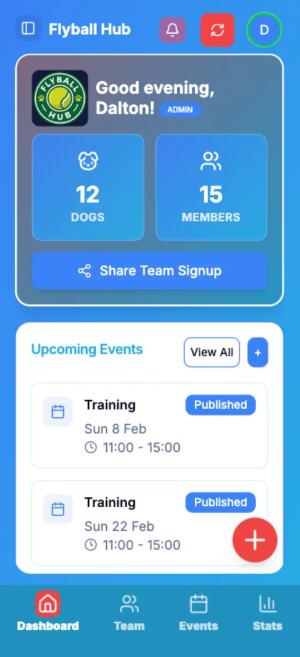
Flyball Hub can help with team management, training progress and tournaments when your club wants one place for the jobs that usually sit with a manager.
An officially recognised event run under an organisation's rules (BFA, UKFL, NAFA, FCI, AFA, EFC, etc.). Results count towards points and records. Non-sanctioned fun days don't award official points.
The main competition class with no restrictions on breed makeup. Any registered dogs can run.
Different words for the same thing - a flyball event. In the UK, "show" is common. Americans tend to say "tournament."
The fenced area containing the lanes, boxes and judging equipment. Teams run in the ring.
Time allocated before racing starts for dogs to practice box turns and get used to the venue. Essential for dogs who get nervous in new environments.
Calling your dog back to you. Strong recall is everything in flyball - your dog needs to run back to you reliably, even with chaos all around them.
The obstacles dogs clear on their way to and from the box. Four hurdles per lane, spaced 3 metres (10 feet) apart.
The complete course - start line, four hurdles, and the box. Standard length is 15.5 metres (51 feet) from start line to box.
The surface dogs run on. Competition matting needs to provide grip without being too hard on joints. Different organisations have different surface requirements.
| Abbreviation | Full Name |
|---|---|
| BFA | British Flyball Association |
| UKFL | UK Flyball League |
| UFO | United Flyball Outdoors |
| NAFA | North American Flyball Association |
| U-FLI | United Flyball League International |
| EFC | European Flyball Championships |
If you hear a term at training that isn't here, ask. Flyball people love talking about the sport, and there's no such thing as a stupid question when you're starting out.
Check out our guide What is Flyball? for the complete beginner's introduction.
Plan training, manage dogs and members, organise competitions, use Team Chat, time runs from video and keep achievements and race-day details together on web, iOS and Android.
Keep dogs, members, RSVPs, line-ups, repeated schedules and achievements tidy without spreadsheet drift
Plan race days, track heats, host public events and keep event comments with the right details
Keep Premium Team Chat in one place, save video timings and review clearer performance trends
Use it on web, iOS or Android