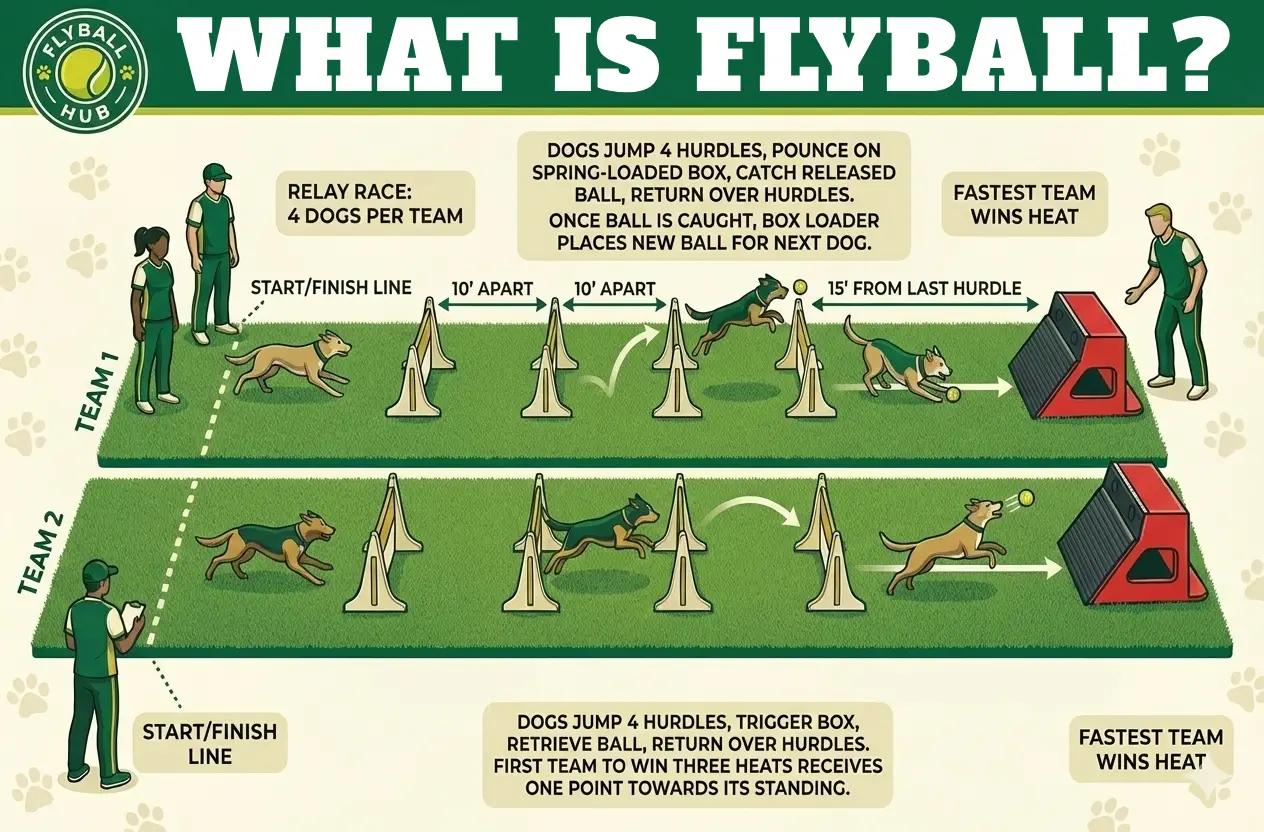
Flyball is a fast‑paced team sport for dogs that combines everything they love: running, jumping, chasing a ball, and working with their humans. In a race, teams of four dogs run one after another over a line of jumps, hit a spring‑loaded box that fires out a tennis ball, grab the ball, and race back over the jumps so the next dog can go. First team to get all four dogs over the finish line cleanly wins.
This guide is written for curious dog owners, new flyballers, and anyone who has seen the sport at a show and wondered, “What on earth is going on?”
We’ll walk through what flyball is, how a race actually works, which dogs can take part, the benefits and safety considerations, and how to get started with your own dog.
Flyball is a relay race between two teams of dogs. Each team usually has:
Each dog, one after another:
As soon as one dog crosses the start/finish line on the way back, the next dog in that team is released. The team that gets all four dogs over the line with no errors, in the fastest time, wins that leg of the race.
Different leagues around the world (like BFA, UKFL, NAFA, UFLI and others) use slightly different rules, but the core idea is always the same: a clean, fast relay where dogs race side by side.
A standard flyball course has:
Exact measurements can vary slightly by league, but a typical course is:
The jump height is set from the team’s height dog (the smallest dog running in that line-up), so mixed-size teams can compete fairly without over-facing smaller dogs.
During a race:
This hand-off between dogs is called the pass (or changeover). Tight, clean passes – where the dogs cross as close as possible without an early start – are a huge part of getting fast team times.
Racing is usually organised into:
This structure means there’s space for everyone, from beginner teams learning the ropes to the fastest teams in the world.
In most leagues, dogs earn lifetime points every time they run in an official, clean race at a sanctioned tournament. Those points add up over their career and unlock a series of titles
The exact system depends on the organisation:
The overall idea is the same: the more clean runs your dog completes at competitions, the more points they earn and the further they climb through the title levels.
| Abbreviation | Title | Points needed | Award |
|---|---|---|---|
| FD | Flyball Dog | 20 | Certificate |
| FDX | Flyball Dog Excellent | 100 | Certificate |
| FDCh | Flyball Dog Champion | 500 | Certificate |
| FDCh Silver | Flyball Dog Champion (Silver) | 1000 | Certificate |
| FDCh Gold | Flyball Dog Champion (Gold) | 2500 | Certificate |
| FM | Flyball Master | 5000 | Pin |
| FMX | Flyball Master Excellent | 10000 | Pin |
| FMCh | Flyball Master Champion | 15000 | Pin |
| ONYX | ONYX Award | 20000 | Plaque |
| FGDCh | Flyball Grand Champion | 30000 | Plaque |
| FGDCh 40k, 50k | Flyball Grand Champion 40k/50k accordingly | 40000/5000 | Plaque |
| Hobbes | Hobbes Award | 100000 | Plaque Addendum |
For detailed, official rules and scoring, your national governing bodies (for example, The Kennel Club, BFA, UKFL, NAFA, UFLI, AFA and others) publish rulebooks on their sites.
If something goes wrong, that dog may have to run again at the end of the line-up. Common faults include:
At the end of the leg, if any dogs have faults, those dogs run again. The winner is the first team to complete four clean runs.
Flyball is a relatively young dog sport. It grew out of scent hurdle racing in Southern California in the late 1960s and early 1970s, when trainers began experimenting with having dogs run over jumps to fetch tennis balls. One of those trainers, Herbert Wagner, is often credited with inventing the first flyball box and later demonstrating the sport on national television, which helped it spread.
From there, flyball clubs formed and early competitions appeared. The North American Flyball Association (NAFA) was founded in the 1980s to standardise rules and sanction tournaments, and other organisations followed around the world. Today, there are dedicated leagues in the UK, Europe, North America, Australia, South Africa and beyond, with major events attracting hundreds of teams.
Flyball looks chaotic from the sidelines, but it’s incredibly rewarding for both dogs and humans. Some of the big reasons people fall in love with it:
Flyball gives dogs a full‑body workout:
Done sensibly and at an appropriate level for the dog, it can help build muscle, improve cardio fitness, and keep them at a healthy weight.
Flyball isn’t just running fast in a straight line. Dogs must:
That mental challenge can be as tiring as the physical work and is brilliant for dogs who easily get bored.
You and your dog are part of a team. You’ll:
All of this builds trust and strengthens your relationship. For people, there’s also the social side: friends, road trips, camping at shows, late‑night ring parties, and a community of equally dog‑obsessed teammates.
Because jump heights are based on the smallest dog on the team, tiny dogs can contribute just as much as their larger teammates. Flyball is open to crossbreeds and pedigree dogs alike.
While the very fastest teams are often made up of high‑drive breeds like Border Collies, Whippets and their crosses, many different breeds and mixes play and enjoy the sport.
In general, any healthy dog who enjoys chasing a ball and working around other dogs can learn flyball.
You’ll often see:
But you’ll also find plenty of rescue mixes and unexpected breeds taking part. A good club will assess each dog as an individual.
Most leagues set a minimum competition age (often around 12–18 months, depending on the organisation) so that young dogs’ joints and growth plates are more mature before they start doing full height and speed.
That doesn’t mean you have to wait that long to start. Puppies and youngsters can work on:
A responsible club will keep this age‑appropriate and low impact.
Flyball is busy and noisy. The ideal flyball dog:
Some reactive or worried dogs can still enjoy flyball with careful management and experienced trainers, but safety and welfare always come first. Good clubs will be honest if the sport isn’t the best fit for a particular dog.
Because flyball is a high‑energy sport, it’s wise to:
If in doubt, always ask your vet and your club’s trainers.
Like any active sport, flyball carries some risk, but there’s a lot clubs and handlers do to keep dogs safe.
Key safety points include:
If your dog limps, seems stiff, slows down unexpectedly, or just “isn’t right”, they should rest and be checked rather than pushed to keep going.
You don’t need to buy everything yourself to get started – most of this will be provided by your club. But it helps to know the basics.
Flyball and agility are both popular dog sports that involve jumps and fast running, but they have some key differences:
Many dogs (and people) enjoy both sports. The skills can complement each other, especially for dogs who love to run.
Ready to have a go? Here’s a simple roadmap.
Before starting any new sport, especially one involving sprinting and jumping:
If your dog has existing joint, heart or breathing issues, your vet can help you decide whether flyball is appropriate.
Be sure to check out our latest blog post on keeping your flyball dog healthy.
Search online for flyball clubs or teams in your country or region, or look at the main league websites. Many clubs:
In many UK leagues, dogs must be around 18 months to compete in full open tournaments, with some starter classes available from roughly 12 months, depending on the rules at the time – your club will guide you on what’s appropriate.
If you’re using Flyball Hub, you’ll be able to use the Find a Team tools to look up clubs near you.
Your dog’s first months in flyball are all about building the right foundations – most of which you can start gently at home:
At club training, these same skills are developed in a structured way, alongside box foundations and controlled work around other dogs.
Over time, as your dog’s skills and fitness improve, you’ll work towards:
Once your dog and team are ready, your club may start entering starter or open competitions. Don’t worry – everyone’s first show feels chaotic. Most people quickly find themselves hooked.
A few words you’ll hear around the lanes:
Puppies shouldn’t be doing full‑height jumps and box turns at speed, but they can absolutely start foundation skills: recalls, toy play, body awareness and confidence‑building games. Most leagues set a minimum age for full competition, so your club will guide you on what’s appropriate.
Many teams train once or twice a week, with competitions on some weekends in the main season. The right amount depends on the dog’s age, fitness, and how intensely they’re working.
Costs vary by country and club, but you’ll usually pay:
Most clubs are run by volunteers and try to keep it as affordable as possible.
Sometimes, yes – but it depends on the dog and the setup. Flyball is noisy and busy, and dogs run close to each other. A good club will assess your dog and may suggest one‑to‑one work or a different sport if flyball would be too stressful.
If you’ve made it this far, you probably already know the answer to “Should I try flyball with my dog?”
If your dog loves to run, chase balls, and work with you, flyball can be an amazing way to channel that energy into something structured and fun.
From here, you can:
Help run a team already? See how the Flyball Hub app handles sessions, RSVPs, dog records and race-day planning.
Then, when you’re ready, grab a tug toy, pack some treats, and head to your first training session. You might just find your new favourite sport.