•Dalton Walsh
Learn why tracking your flyball dog's PBs and race times helps you train smarter, spot problems early, and build better teams. Plus practical ways to log stats.
By Dalton Walsh
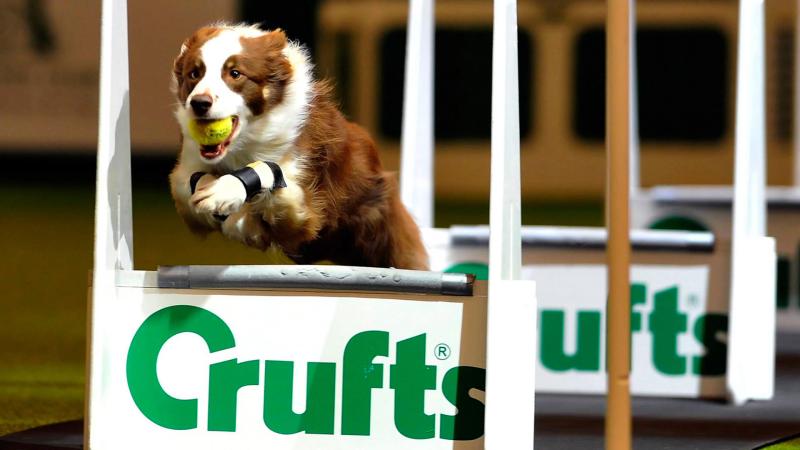
In flyball, we all love a good PB. That moment when your dog shaves a little bit off their time is electric – for you, your team and everyone watching.
But if you're only celebrating the occasional PB announcement on the lane, you're missing a huge amount of useful information.
Consistently tracking your dog's times and race stats can:
Make training more focused
Help you spot patterns and problems earlier
Give captains better data for seeding and team selection
Keep you motivated when progress feels slow
In this post we'll look at why it's worth tracking your dog's PBs and individual times, what to record, and a few different ways you can stay on top of it – from simple notebooks to using a dedicated app like Flyball Hub.
Most dogs don't smash a PB every competition. Progress often looks like:
Fewer "blow-out" runs
More runs clustered close to their best
Better consistency across different surfaces and venues
If you're logging times after each race or training session, you can:
See your dog's average time dropping over months
Notice that bad runs are becoming less frequent
Spot that they actually are getting faster, even if the PB hasn't fallen for a while
That's a lot more encouraging than waiting for the stars to align for one magic run.
Times don't exist in a vacuum. When you log extra details alongside each run, patterns jump out:
Surface (mats, grass, indoor, outdoor)
Box type or club you were racing against
Time of day / day of weekend
Weather (hot, wet, windy)
Notes like "late pass", "steady start", "tired", "first show back after break"
Over time this helps you answer questions like:
"Does my dog struggle more on slippy grass?"
"Are we always slower on day two of a weekend?"
"Did that change of stride / turn actually help?"
Instead of guessing, you can tweak training to match what the numbers are telling you.
Captains already juggle a lot: dog heights, box turns, handlers, line-ups, passes…
Having a clear view of each dog's:
Lifetime PB
Current realistic racing time (what they can repeatedly hit, not just once)
Consistency band (e.g. usually between 4.9 – 5.2s)
…makes it much easier to:
Build line-ups for different seeds and divisions
Plan "stretch" teams vs more reliable ones
Decide where a new or young dog best fits
Spot when a dog might be struggling or regressing
Good data takes a lot of the stress and guesswork out of team selection.
If a normally reliable dog suddenly starts adding half a second or more to all their times, that's a red flag.
By tracking times regularly, especially across a whole season, you can quickly see when:
A dog is slowing down in a way that doesn't match the rest of the team
Times are getting worse after a particular exercise or surface
They're not bouncing back after time off
That's your cue to ease off, check for injuries, or chat with your vet – before things turn into a bigger problem.
You don't have to go full spreadsheet nerd (unless you want to!) but a good baseline log for each run or PB might include:
Dog – which dog the time belongs to
Time (seconds) – to two decimal places if possible
Date – so you can see progress over weeks/months/years
Location / event – the show or venue name
Run type – race, warm-up, pairs, single dog, training session etc.
Surface / conditions – grass, mats, indoor, outdoor, hot, wet, windy…
Notes – anything that affected the run: late pass, bobble, distraction, injury, handler error, "New PB!", etc.
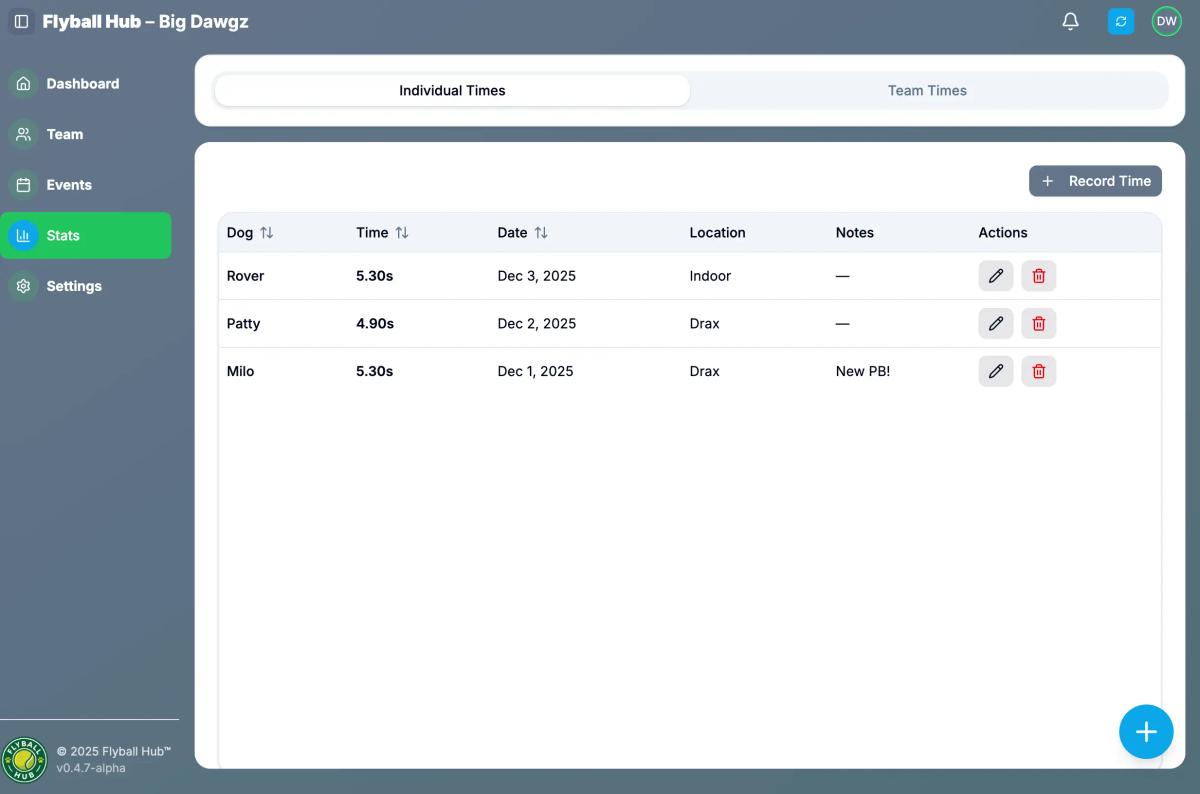
In Flyball Hub we log most of this in a simple form:
Choose the dog from a dropdown
Enter the time in seconds
Pick the date
Add a location and optional notes
Then it all appears in a tidy table you can sort by dog, time or date – so you can quickly see improvements and PBs at a glance.
You can do the same thing on paper or in a spreadsheet; the key is being consistent.
The classic option:
Cheap, portable, no battery required
Easy to quickly jot things down between races
Feels quite satisfying to look back over years of scribbles
Downside: it's hard to sort, filter or share the data later. If your captain needs everyone's up-to-date times for seeding, someone still has to type it all up.
A simple spreadsheet (Google Sheets, Excel, Numbers) is a big step up:
You can have a tab per dog or one big table for the whole team
Filter by show, date range or dog
Calculate average times, best times per venue, season PBs, etc.
If you're the kind of person who already lives in Google Sheets, this might be enough.
The catch is keeping it updated – especially mid-show when everything is hectic – and sharing edit access safely with the rest of the team.
Apps are built to solve exactly this sort of problem:
Quick entry: tap "Record time", pick the dog, type the time, done
Sorted tables by default: instantly see fastest times, most recent runs, etc.
Shared access: captains, handlers and owners all see the same data
Tied into the rest of your team info: dogs, sub-teams, events, training sessions
In Flyball Hub, for example:
Each team gets a Stats page with a table of individual times
You can sort by dog, time, date to find PBs or see recent runs
Notes like "New PB!" or "Indoor mats – slippery" help you remember context later
Over time, those logs can feed into future features like per-dog progress graphs and team best-time summaries
Whether you use our app or another tool, the goal is the same: make it easy enough that people actually keep logging times, even during a busy show weekend.
One useful mindset shift is to separate three different numbers for each dog:
Lifetime PB – the absolute quickest they've ever run
Current racing time – what they can hit reliably right now
Goal time – a realistic next target based on their age and experience
Your PB might be a unicorn run where:
Every pass was perfect
The dog was extra fired up
The lane suited them
Conditions were ideal
That's great to celebrate, but captains need the current racing time when they're building teams. Consistent logging helps you set that realistically, instead of guessing from memory.
Goal times then give you and your trainer something to work towards over a season.
A stats system is only useful if people actually use it. A few practical tips:
Log times as soon as you can – between races, or at least at the end of each day
Have one person responsible per team or per sub-team for entering times
Decide what counts – do you log every run, only clean runs, or only PB contenders? Make sure everyone's on the same page
Separate training and racing – you might want a flag for "training" vs "competition" so you can filter later
Review them regularly – make time every month or so to look through the stats and talk about what they're telling you
The more you build the habit, the more valuable your data becomes.
Tracking your dog's PBs and individual times isn't just about bragging rights (although that's fun too). Done well, it:
Shows real progress over time
Helps you train smarter and keep dogs healthier
Makes captains' lives easier when building teams
Gives the whole club something concrete to celebrate
You can do it with pen and paper, a spreadsheet, or a dedicated app.
If your team wants a shared, easy way to log times, sort them and keep everyone in sync, that's exactly what the Stats section in Flyball Hub is built for – alongside managing your teams, events and training sessions.
If you are just getting started, find a flyball team near you for regular training, experienced advice and a team to share those PBs with.
However you choose to track them, start recording those times now. In a season or two, you'll be glad you did when you can look back and see just how far your dogs (and your team) have come.